Geschwister Bahn/Giefer-Bahn
Masterwork Geschwister Bahn Sgraffito Wall Charger
Masterwork Geschwister Bahn Sgraffito Wall Charger
1 in stock
Couldn't load pickup availability
A monumental statement piece of mid-century German studio pottery. This 37.4 cm charger was handcrafted in the renowned Höhr-Grenzhausen studios of Geschwister Bahn (also known as Giefer-Bahn).
This exceptional piece features a striking central sunburst surrounded by stylized floral motifs in a sophisticated palette of cobalt blue and manganese brown. The decoration is executed in the meticulous Sgraffito technique—hand-carved through a dark slip to reveal the pale grey salt-glazed stoneware body beneath.
Dimensions
Dimensions
- Diameter: 37.4 cm.
- Depth (from wall): 7 cm.
- Scale: Classified as a "Master" size charger, significantly larger than standard production plates or bowls from this era.
- Weight: This is a heavy piece, indicative of the high-density, high-fired Westerwald stoneware clay used in the Geschwister Bahn studio.
Condition
Condition
- Excellent - This charger is in pristine vintage condition, showing remarkable preservation for a piece of its age.
- Surface Integrity: There are no chips, cracks, hairlines, or restorations visible on either the decorated face or the reverse.
- Glaze Quality: The salt-glaze finish is crisp and uniform, retaining its original lustre and the iconic "orange peel" tactile texture without any significant surface wear.
- Pigment & Decoration: The cobalt blue and manganese sgraffito details remain vibrant and well-defined, with no fading or loss to the hand-carved motifs.
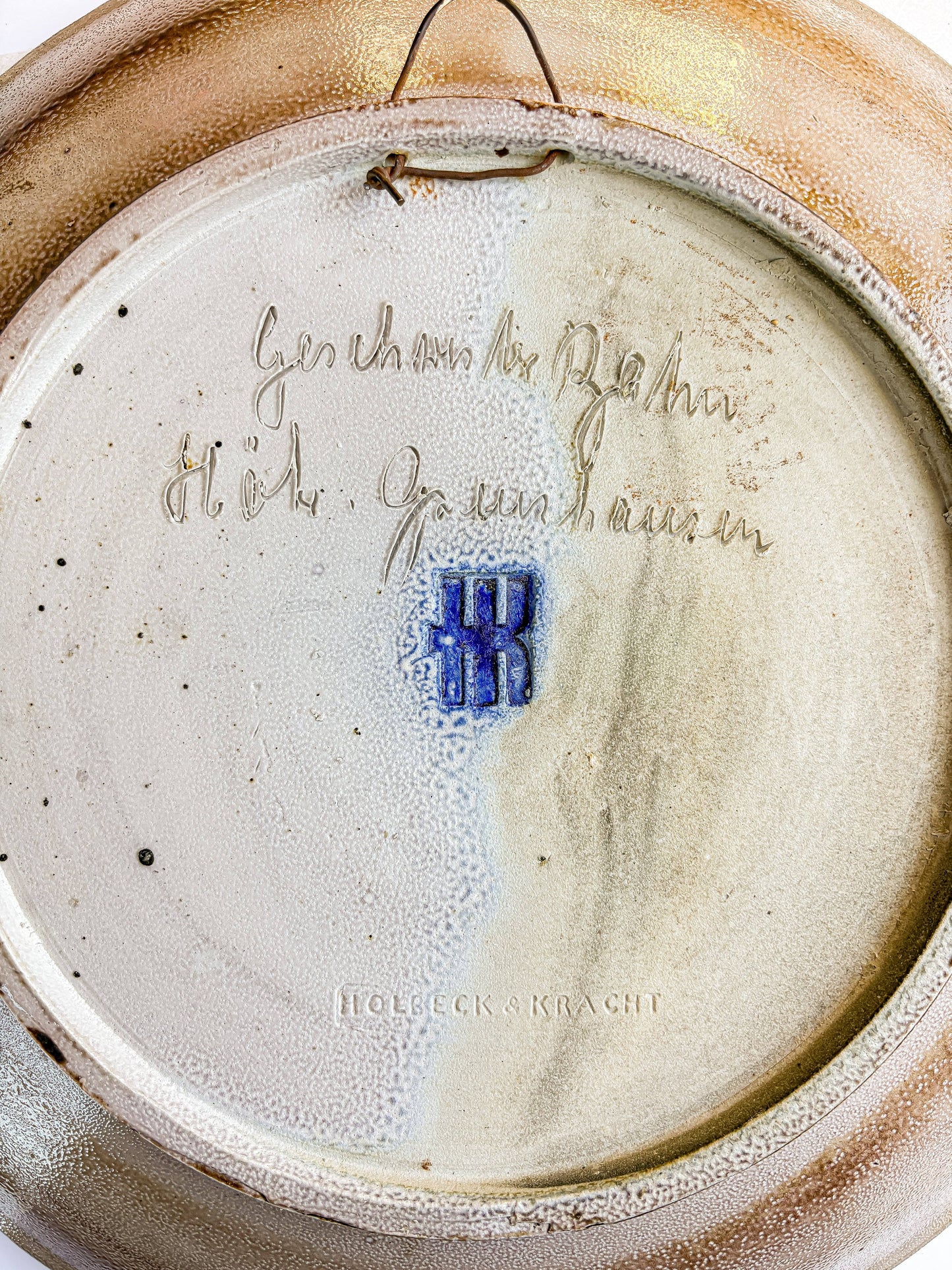
- Mounting Hardware: The original heavy-duty copper hanging wire is securely attached and remains functional for wall display.
Additional Information
Additional Information
1. Design & Features
- Oversized "Master" Charger: At 37.4 cm, this is a significant scale for studio ceramics, designed specifically as a high-impact wall-hanging art piece.
- Signature "Checkered Heart" Pattern: A hallmark of the Geschwister Bahn workshop, blending traditional Germanic folk motifs with the bold, geometric lines of Mid-Century Modernism.
- Contrasting Palette: The sophisticated use of cobalt blue and deep manganese brown against the natural grey stoneware creates a striking visual depth that works across both period and contemporary interiors.
2. Craftsmanship: The Sgraffito Technique
- The decoration on this piece is not merely painted on; it is carved into the physical body of the clay.
- Hand-Carved Precision: The artist applied a layer of coloured slip (liquid clay) and then, while the piece was "leather-hard," meticulously scratched the design through to reveal the pale clay beneath.
- Tactile Texture: Because of the sgraffito reduction process, the uncarved dark areas sit slightly higher than the grey carved lines, giving the surface a unique, three-dimensional feel.
- Authentic Salt-Glaze: Fired at extreme temperatures (approx. 1200°C), vaporised salt fused with the clay to create an "orange peel" vitrified finish that is famously acid-resistant and durable.
3. The HK Workshop & Gallery Markings
- The markings on the reverse of this charger provide a clear record of its high-end provenance.
- The HK Mark: This blue embossed square is the specific workshop mark for the Kunsttöpferei (Art Pottery) line of the Geschwister Bahn studio. It was used to distinguish their handcrafted art pieces from more standard utilitarian ware.
- Holbeck & Kracht: The secondary stamped mark refers to a prestigious art retailer or gallery. In the mid-century era, such markings were typically added by elite distributors to certify that the piece met the rigorous standards of a gallery-grade collection.
4. About the Artist: Klothilde Giefer-Bahn (1924–2008)
- Klothilde Giefer-Bahn was a master of German studio ceramics whose work bridged the gap between traditional craftsmanship and modern art. Her career was defined by a deep mastery of materials and a commitment to the historic techniques of the Westerwald region.
- Early Training & Education: Born in Koblenz in 1924, she began her formal pottery apprenticeship in 1938 with the highly respected ceramicist Elfriede Balzar-Kopp.
- Academic Excellence: Following her apprenticeship, she studied at the State Technical School of Ceramics in Höhr-Grenzhausen, graduating as a ceramic engineer in 1945.
- Master Status: In 1947, she completed her master’s examination as a Master of Ceramics, finishing at the top of her class.
- The Studio: That same year, the "Geschwister Bahn" (sibling) pottery was founded in Höhr-Grenzhausen by Kunal Giefer-Bahn, where Klothilde's artistic vision flourished.
- Artistic Focus: Her lifelong focus remained on traditional salt-glazed stoneware. She was widely celebrated for her ability to use the labour-intensive sgraffito technique to create intricate, modernist designs on vessels, animal figures, and sculptures.
- Legacy: Her contributions to the field were honoured with a solo exhibition at the Westerwald Ceramics Museum on the occasion of her 80th birthday.
5. Uses & Versatility
- Curated Wall Art: Equipped with its original heavy-duty copper wire, it is intended to be displayed as a centrepiece on a gallery wall or above a mid-century sideboard.
- Tabletop Centrepiece: While originally for display, its 7 cm depth makes it a dramatic base for dry floral arrangements or as a "charger" for a formal dining setting (note: not intended for direct food contact).
- Investment Grade: Signed pieces by Klothilde Giefer-Bahn are increasingly sought after by collectors of West German Art Pottery (WGP) as her work is viewed as a bridge between traditional craft and modernist art.
Share