Unknown Manufacturer
A Pair of Miniature ‘Tobi Seiji’ Spotted Celadon Vases
A Pair of Miniature ‘Tobi Seiji’ Spotted Celadon Vases
1 in stock
Couldn't load pickup availability
This charming pair of petite bottle vases is a mid-20th-century tribute to the celebrated Longquan tradition. Finished in a luminous, high-gloss ‘Kinuta’ celadon glaze—a fresh sea-green—each piece is decorated with intentional iron-brown splashes known as Tobi Seiji (or ‘flying celadon’).
While inspired by 14th-century forms, these vases exhibit the refined, crisp white porcelain body and well-finished foot-rims characteristic of the Republic Period. They are quintessential Scholar’s Objects, designed to be admired for their symmetry and the tactile nature of their glaze.
Dimensions
Dimensions
- Height of vase (excluding the stand): 7.1 cm
- Diameter of vase: 6.2 cm
Condition
Condition
1. Vases:
- Overall Grade: Excellent / Near Mint.
- Glaze Integrity: The celadon glaze is stable with a high-gloss finish. No signs of crazing (fine surface cracking) or glaze pops (small air bubbles from the kiln).
- Structural State: No chips, cracks, or hairline fractures. The rims and the bulbous bodies are smooth and intact.
- The "Spots": The ferruginous (iron) splashes are intentional and chemically stable. As noted, there is characteristic pitting within the spots—this is a manufacturing trait, not damage.
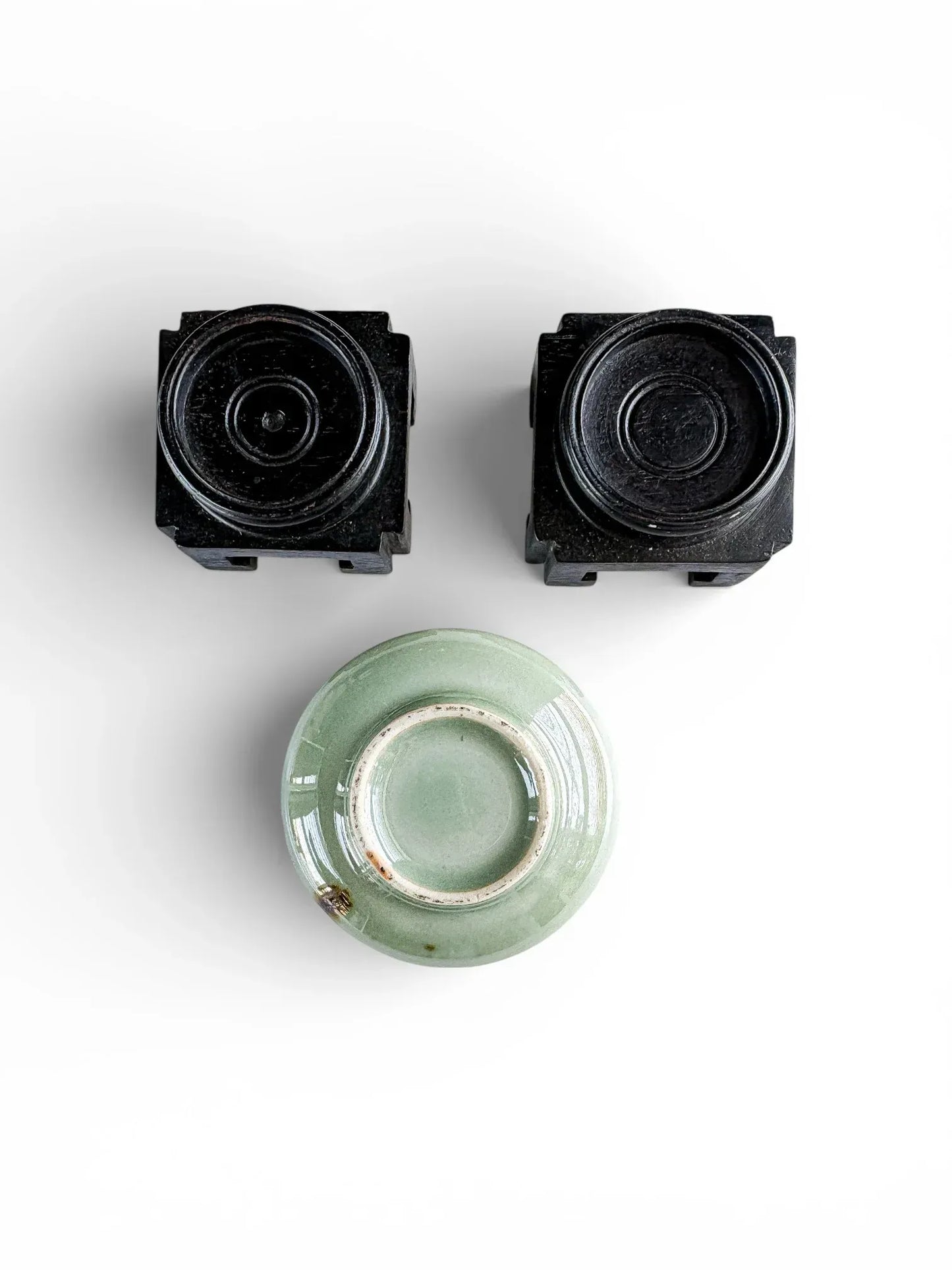
- Foot-Rims: The unglazed bases are "crisp white" and well-finished. There is negligible shelf-wear (rubbing marks on the bottom), suggesting they have been kept on their stands for most of their life.
2. The Hardwood Stands
- Condition: Very Good.
- Surface: The dark stain is consistent with a gentle age-related patina. No major scratches, gouges, or sun-fading.
- Stability: Both stands are structurally sound with no loose "Ruyi-head" feet or wobbling.
Additional Information
Additional Information
1. Design & Features
- The Silhouette: These are miniature ‘Garlic-head’ bottle vases (or Suantouping). This classic shape features a compressed globular body and a slender, tapering neck that swells slightly at the rim, resembling a head of garlic.
- The Glaze: A luminous Kinuta-style celadon. "Kinuta" is the Japanese term for a high-quality, bluish-green glaze that was traditionally compared to the surface of polished jade or ice.
- The Tobi Seiji Spots: The most distinctive feature is the scattered iron-brown splashes. Known as Tobi Seiji (meaning "flying celadon"), these spots provide a bold, dramatic contrast against the serene green background.
- The Stands: Each vase is paired with a custom-fitted, dark-stained hardwood pedestal. These ‘Ruyi-head’ or cloud-carved stands are designed to elevate the vases both physically and aesthetically, marking them as formal display pieces.
2. Origin
- Geographic Roots: While these were likely made in the mid-20th century (Republic Period), they are a direct tribute to the Longquan kilns in China's Zhejiang province, which have been the heart of celadon production for over 800 years.
- The Style’s History: The Tobi Seiji technique gained immense popularity during the Yuan Dynasty (1271–1368).
- While originally prized in China, these wares were highly coveted by Japanese tea masters, which is why the Japanese terminology is still the global standard for this style today.
3. Craftsmanship
- The Spotted Technique: Unlike painted patterns, these spots were applied using an iron-rich mineral slip onto the unfired glaze. During the high-heat firing process, the iron mineral reacts with the silica in the glaze.
- The "Pitting": The slight tactile indentation or pitting you feel in the centre of the spots is a hallmark of authentic craftsmanship; it happens as the iron "melts" into the glaze, creating a unique, three-dimensional texture.
- Refinement: The "crisp white" porcelain body and neatly trimmed foot-rims show the precision of 20th-century porcelain production. This refined "bone" allows the green glaze to appear more vivid and clear than older, earthier stonewares.
4. Uses & Versatility
- The Scholar’s Desk: Traditionally, miniature vases like these served as Scholar’s Objects (Wenfang). They were used to hold a single small flower sprig (like a plum blossom) or simply as meditative objects on a calligrapher’s desk.
- The Curio Cabinet: Their size makes them perfect for a Curio Cabinet (Duobaoge), where collectors would display small treasures in a staggered, asymmetrical arrangement.
- The Styled Bookshelf: Use them as a matching pair to bookend a small stack of design books.
- The Bedside Vignette: Their calming sea-green hue makes them perfect for a minimalist nightstand.
5. Care Instructions:
- As these are high-fired porcelain, they are quite hardy, but the wooden stands are sensitive.
- Avoid using any liquid cleaners or oils on the stands; a soft, dry artist’s paintbrush is the best tool for dusting the intricate carvings and the necks of the vases.
Share