Grazia Deruta
Italian Lustreware Serpent Amphora | Attributed to the Grazia Deruta
Italian Lustreware Serpent Amphora | Attributed to the Grazia Deruta
1 in stock
Couldn't load pickup availability
A masterclass in the Italian Renaissance revival. This mid-century Majolica amphora features the iconic "Raffaellesco" pattern, entirely hand-painted in the historic pottery centre of Deruta. The showstoppers are the twin serpent handles, or Hydras, which have been expertly applied and finished with a shimmering metallic lustre.
This amphora has a commanding presence. It works beautifully as a standalone centerpiece on a sideboard or styled amongst leather-bound books. Because traditional Majolica is porous, we recommend using it for dried botanicals
Dimensions
Dimensions
- Height: 35.5 cm
- Length (handle to handle): 23.2 cm
Condition
Condition
- Very Good - This amphora is in very good vintage condition for its age and delicate form, though it does carry the gentle marks of its history:
Structure: Structurally sound with no major chips, repairs, or restorations. The intricate serpent handles—often the first point of damage on these pieces—are remarkably well-preserved and entirely intact.
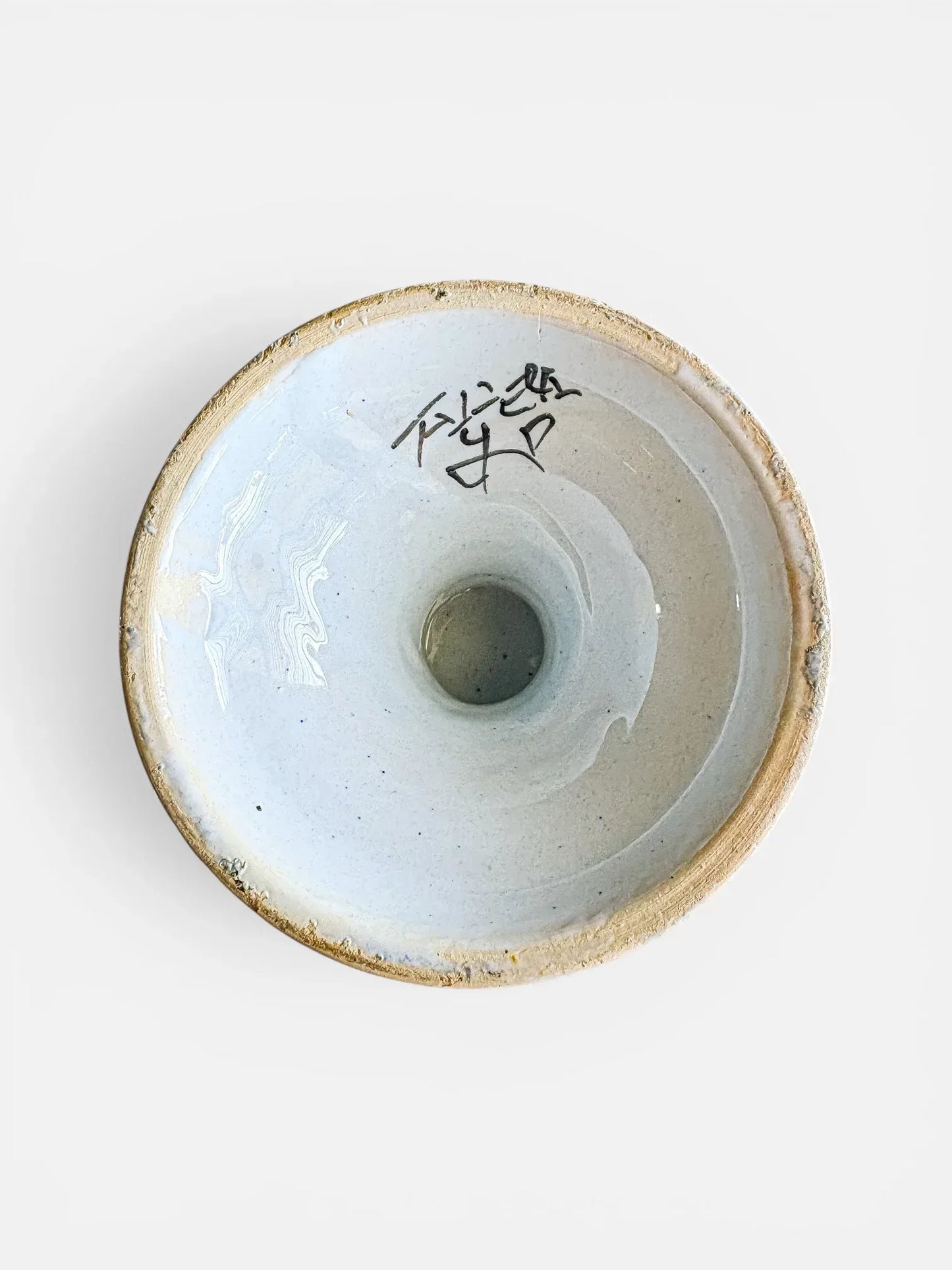
The Glaze: There is a fine, stable hairline crack visible at the base of the foot (see photos). This appears to be a superficial glaze line rather than a deep structural fracture, likely occurring during the kiln cooling process. It does not affect the stability of the piece.
Surface Details: You will find minor "pitting" and tiny glaze pops across the body and base. These are not flaws, but rather the "fingerprints" of the traditional tin-glazing process, confirming its hand-crafted, artisanal origin.
The Lustre: The iridescent finish on the serpents remains vibrant with minimal rubbing, retaining its characteristic "oil-on-water" shimmer.
Additional Information
Additional Information
1. Design & Features
- The amphora follows a classical silhouette, characterised by its high, slender neck and wide, sweeping shoulders.
- The Raffaellesco motif—a style born in the 16th century—is rendered here in a vibrant palette of copper green, ochre, and cobalt.
- The focal point remains the applied serpent handles; their coiled forms provide a sharp, sculptural contrast to the smooth curves of the vessel body.
2. Craftsmanship
- This is a high-skill piece of Majolica (tin-glazed earthenware).
- The Build: The body was thrown on a potter’s wheel, while the serpents were hand-moulded and "luted" (attached with liquid clay) before the first firing.
- The Glaze: A thick, opaque white tin glaze provides the canvas for the hand-painted mineral pigments.
- The Lustre: The iridescent "oil-on-water" sheen on the serpents requires a dangerous third firing in a smoke-filled kiln—a process few workshops outside of Deruta have mastered.
3. Uses & Versatility
- While technically a vase, this amphora functions best as a sculptural object.
- Mantelpiece Anchor: Its height and symmetry make it an ideal anchor for a display or a large sideboard.
- Textural Contrast: The metallic lustre of the serpents provides a brilliant counterpoint to matte surfaces like reclaimed wood or linen-fold panelling.
- Heritage Styling: It sits perfectly within a maximalist "Grand Tour" aesthetic but can also act as a singular, storied pop of colour in a more minimalist, neutral space.
Share